
The new nitrogen
Our plasma turns air, water and electricity into nitrate. Any site, any scale.
Scroll to exploreThe world fixes its nitrogen in a few hundred places.
170 megatons of it is produced every year. The producers cluster around cheap natural gas or coal, the feedstock the whole industry is built on.
From there it travels the globe along major supply lines.
A few exporters feed the rest of the world. The heaviest lines are billions of dollars of fertiliser leaving a small number of gas-rich countries.
At the other end are hundreds of millions of users, spread thin.
There are roughly 2.3 million farms for every nitrogen fertiliser plant on the map. But food is not the full story. The critical elements necessary to sustain our industries are extracted from the ground with nitrogen too. A few hundred producers, hundreds of millions of dependants: that is the vulnerability.
- Farmland using nitrogen
- Mines
Electricity, however, is already generated where the nitrogen is used.
The map shows the distribution of renewable electricity generation — 108,605 plants. In a single generation, making electricity stopped being something a country does in a few places and became something it does in thousands. The power is already next to the farm, the greenhouse and the mine. The nitrogen is the only part still being shipped.
- Farmland using nitrogen
- Renewable generation, sized by capacity
It’s simple really.
The new nitrogen is electric.
Nitrate from air. Anywhere.
N2 Applied builds nitrate systems that fix nitrogen straight out of air, on electricity alone. No fossil gas. No ammonia intermediate. No freight. Two processes on a skid, inside a shipping container. Skip the reformer, synthesis loop and the 300-bar vessels. The same design serves 30 tons per year on a farm or 3 000 on an industrial site.
Our platform, enabled by advances in plasma technology, power electronics and absorption systems, has revitalised plasma-based nitrogen fixation as an alternative to conventional nitrate production.

Nitrate is the most valuable thing nitrogen becomes.
It is the form a plant can take up the moment it lands, which is why greenhouses and fertigation buy it and why it carries a premium over other nitrogen compounds. It is also what a mine blasts with, what nylon starts as, and what a dozen industrial chemistries are built on.
- Fertiliser60% · 9.6 Mt
- Mining20% · 3.2 Mt
- Industry20% · 3.2 Mt
Nine per cent of the world's reactive nitrogen, and the share that carries the premium.
Three ways in.
Local nitrate production
Regional fertiliser production or on-site nitrate production for the industry.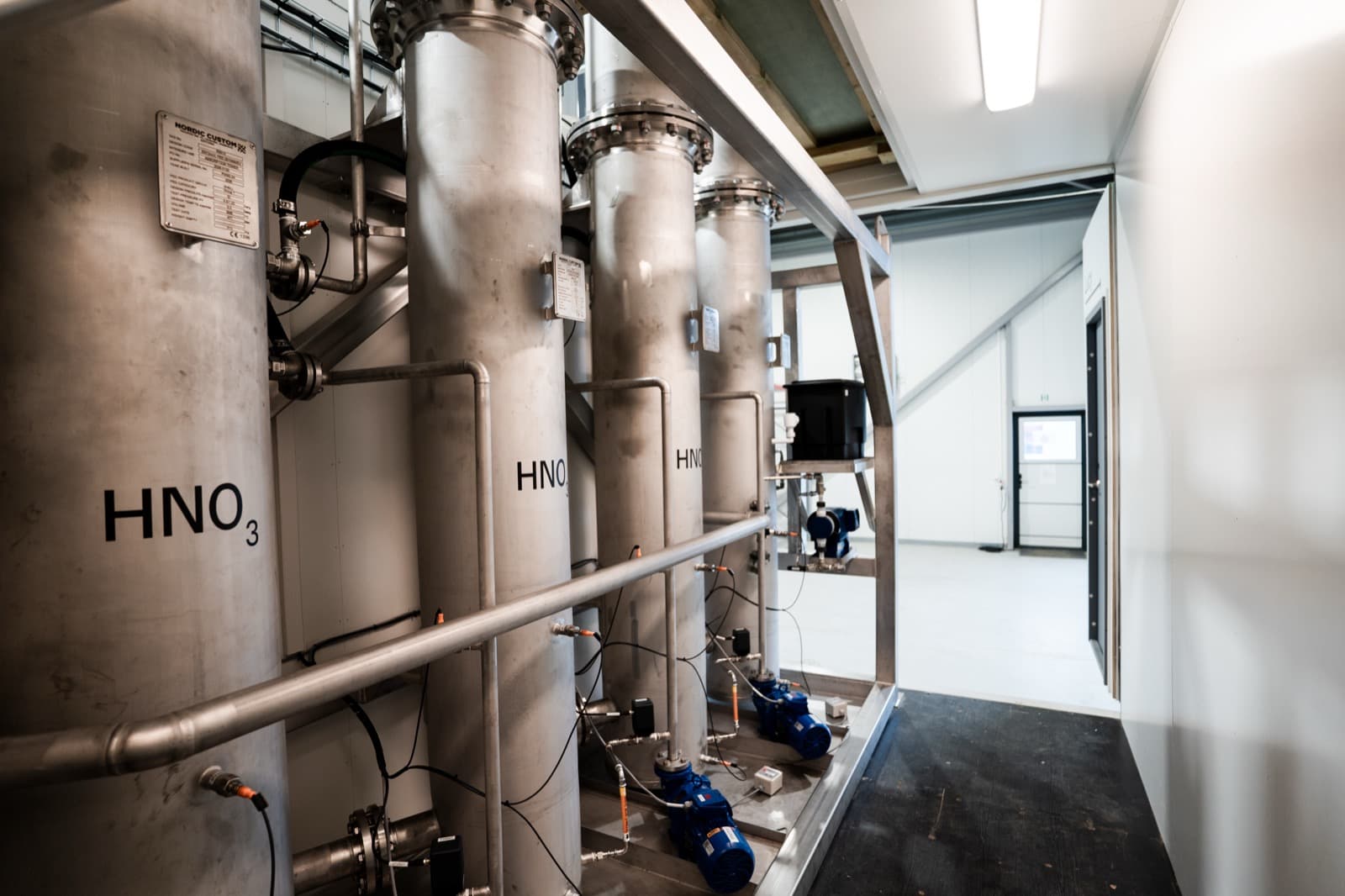
Electrification of existing assets
A nitric acid booster or urea revamp, integrated into an existing plant with air and electricity as the only input.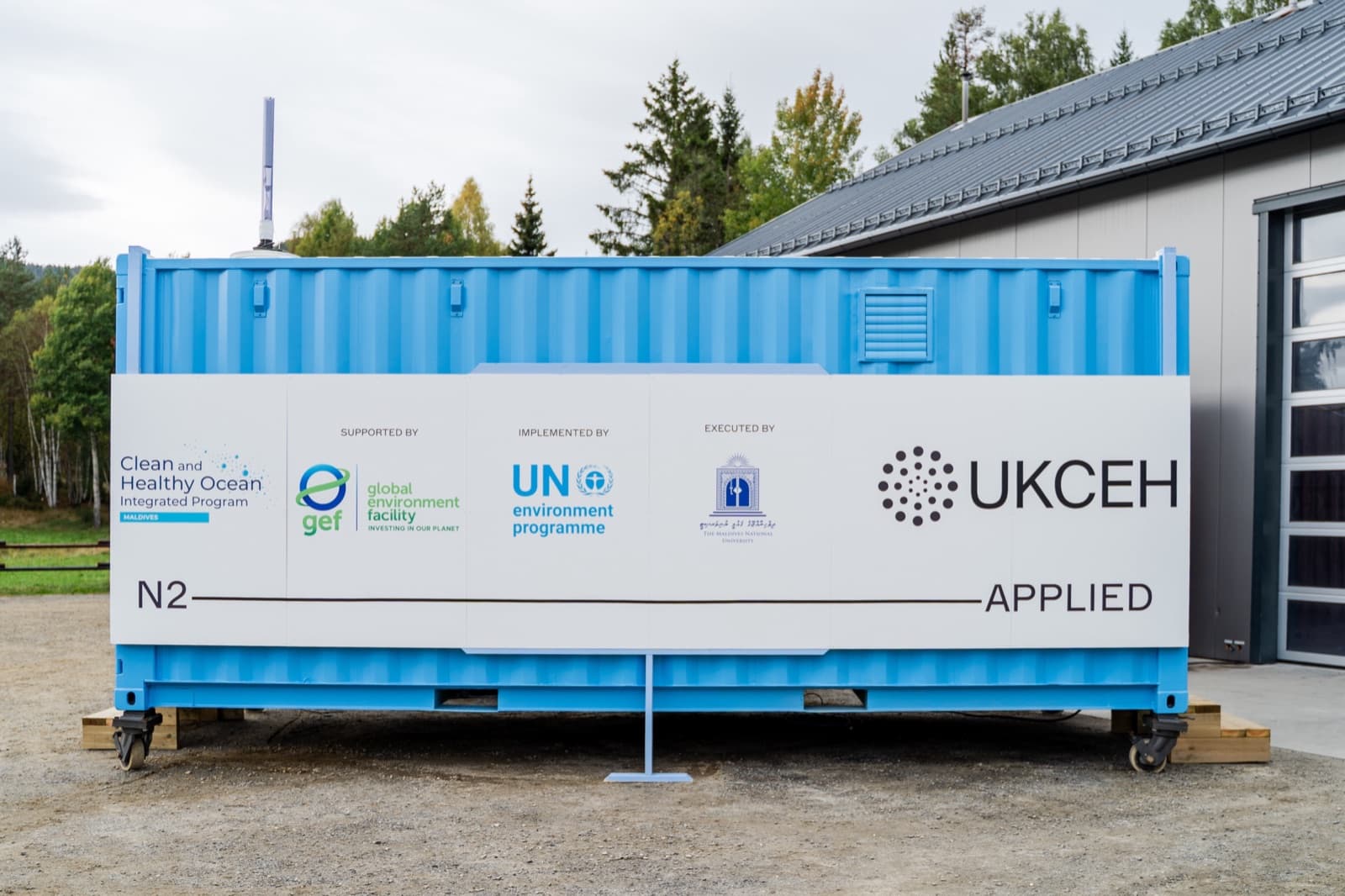
Recover nitrogen from waste streams
Wastewater, manure and digestate upgraded to nitrogen-enriched fertiliser instead of going to waste.FAQ.
Nitrate is 16 of 167 million tonnes. Aren't you chasing 9% of the nitrogen market?Yes — the most valuable 9%, and the beachhead rather than the ceiling.
Yes, urea is the volume, but nitrate is the most valuable commodity. It is the compound that carries the premium: the plant takes it up immediately, it is what greenhouses and fertigation systems buy, and a fifth of it goes into explosives, where the buyer is a mine and the alternative is a truck from the coast. Starting where the value density is highest is the point, not a limitation — and 32 bn USD of nitrate is not a small pond.
Nitrate is also the most complicated compound to produce. Every tonne of it made today starts at a gas field or a coal mine: the gas or the coal becomes ammonia through Haber–Bosch, and only then is that ammonia burned over precious metal through the Ostwald process to make the acid. Ten unit operations across two plants, with the ammonia stored and shipped between them. That is the chain with the most to gain from being shortened, and nitrate is the product where making it where it is used takes the most steps out.
The share the technology can reach is much larger than that, because urea is not a preference, it is a compromise. Urea is shipped because it travels well, not because it grows more: on the field it loses nitrogen to ammonia volatilisation, and its efficiency depends on rain and incorporation that the farmer does not control. Nitrate is taken up directly, and making it locally at a price set by a power contract removes the reason urea won in the first place.
Nitrogen-enriched organic fertiliser goes further still: the nitrogen is fed straight into the farm’s own slurry or digestate, which fixes the ammonia that would otherwise be lost, keeps the carbon and the potassium and phosphorus already in it, and returns a complete fertiliser made on the farm that spreads it. That product competes with urea on delivered cost per kilo of nitrogen taken up by the crop — and it is where the volume of the nitrogen market is.
Plasma nitrogen fixation lost to Haber–Bosch in 1913. Why is it different now?Because three of the four things that beat it have changed.
How much greenhouse gas does the conventional chain emit, and how much of it can this actually remove?Five per cent of global greenhouse gas emissions, from three stages along the chain.
Mineral and organic fertiliser contribute 5% of global greenhouse gas emissions, through production, handling and use. That is 2.6 GtCO₂e in 2019 — synthetic nitrogen and manure together, across the whole chain.
The five per cent sits in three places.
1.5% is production — CO₂ and N₂O. Ammonia is one of the most carbon-intensive commodities there is, at roughly 2.4 tonnes of CO₂ per tonne of ammonia and about 450 Mt of direct CO₂ a year, because the natural gas is the hydrogen as well as the fuel. The Ostwald step that follows adds nitrous oxide, some 273 times as potent as CO₂: an unabated nitric acid plant emits around 8 kg of N₂O per tonne of acid, and even in industrialised countries nitric acid still accounts for about three quarters of the chemical industry's process N₂O.
1% is handling, primarily of organic fertilisers such as manure and biogas digestate. Methane coming off them in storage, mainly, with some N₂O alongside. As livestock production is concentrated into fewer, larger holdings and the weather warms, the methane coming off manure storage will rise. The mineral chain has no equivalent — its handling cost is freight, which does emit CO₂ but not much of it.
2.5% is use, and both types pay it. Ammonia volatilises off organic fertiliser and off urea, and comes back down as indirect N₂O; on top of that is the direct N₂O the soil gives off. Both are made worse by the same thing — applying more nitrogen than the crop can take up.
Narrow it to synthetic nitrogen alone and the per-tonne arithmetic comes out at 1.13 GtCO₂e in 2018, 2.1% of global emissions, averaging 10.5 tonnes of CO₂e per tonne of nitrogen consumed, split 38.8% production, 58.6% field, 2.6% transport.
Take the three blocks in turn.
Production is no longer fossil. There is no reformer, so there is no process CO₂ — the only carbon left is whatever the electricity carries, which is zero on a renewable contract and falling everywhere else. There is no ammonia oxidation over platinum either, and that is where the process N₂O is formed, so the stream does not exist to be abated rather than being abated. The unit also sits where the nitrogen is used, so most of the freight goes with it. On those per-tonne figures, production and transport together are about 4 tonnes of CO₂e per tonne of nitrogen on the conventional chain.
Handling stops emitting, because the storage does. The acid goes straight into the farm's own manure or biogas digestate. Enriching the stream with nitrogen stops the methane coming off it in store, and fixes the ammonia that would otherwise volatilise away instead of losing it — which is most of the one per cent, since that block is primarily organic.
Use gets more efficient, which is the only thing that moves N₂O. Less ammonia lost means less of the indirect N₂O that follows it back down. And a nitrate product that can be fertigated is applied in the amount and at the moment the crop can take it up, rather than spread ahead of the season and hoped for — so less nitrogen is applied in excess, and excess is what the direct N₂O comes off.
The production block is removed by construction and can be counted. The handling and use gains depend on what the farm does with the product, so they are a case to be made on each site rather than a number to be booked. On today's European carbon price the production block alone is a real number in the delivered cost, and CBAM puts it on imports too.